


National Geographic 1991 October
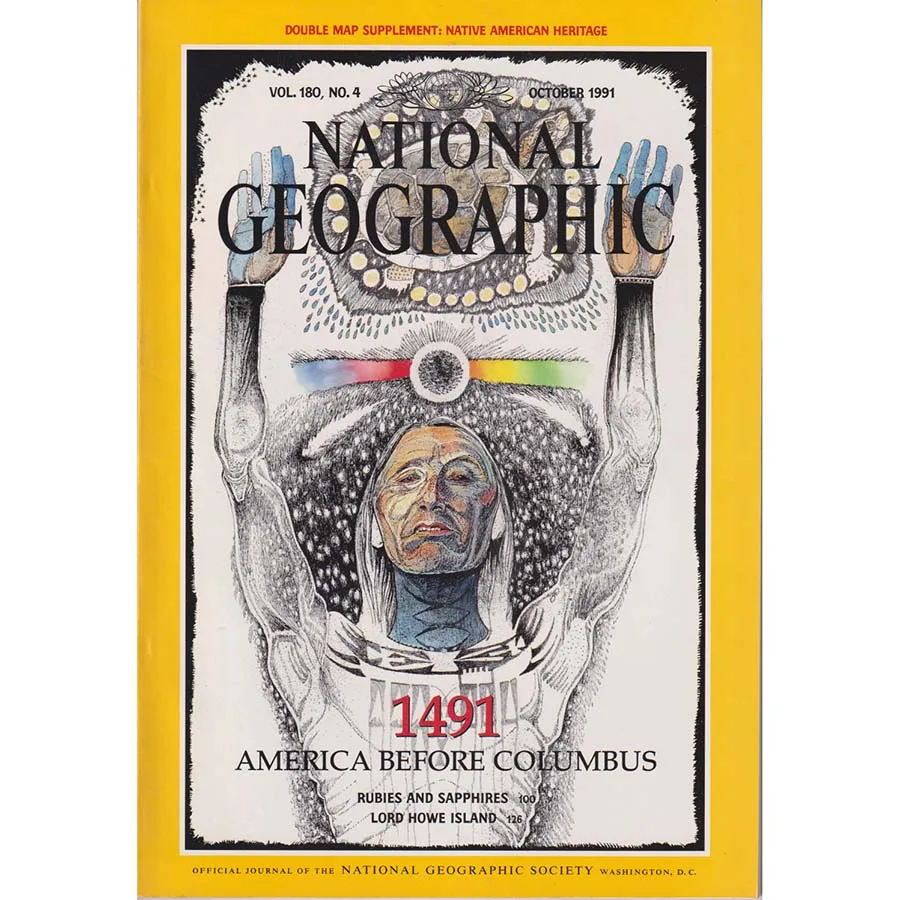
Publisher: National Geographic
Format: Paperback
ISBN: none
National Geographic, October 1991: the issue that turns up with the quiet confidence of a museum exhibition poster and says, “Right then, let’s tidy up a whole continent’s worth of misconceptions before lunch.”
The headline is 1491: America Before Columbus, and it’s doing a very specific early-90s Nat Geo thing: taking a story most people think they already know, rewinding the tape, and revealing all the rich, complex, inconvenient detail that got flattened into a single classroom sentence. “America before Columbus” isn’t a blank space waiting for an arrival; it’s a crowded, brilliant, diverse world—societies, trade, agriculture, cities, art, belief systems, engineering, and centuries of history that deserve to be treated as history, not “pre-history.”
The cover art is striking: a stylised figure with raised arms, cosmic motifs, and that bold 1491 stamped in red like a date that’s about to start an argument. And it’s framed by the banner Double Map Supplement: Native American Heritage, which is Nat Geo’s way of adding, “Also, here’s a giant fold-out map because we’re not just telling you this, we’re mapping it.” You will, naturally, unfold it once with awe and then spend ten minutes trying to fold it back while questioning your hand–eye coordination and your life choices.
Inside, expect a big, thoughtful feature that tries to do justice to scale and variety: not one “Native American story,” but many, across different regions and time periods. It’s the kind of article that makes you realise how much language matters—how “discovery” is a word that depends entirely on who’s holding the pen. The irony is that in 1991 this still feels like a corrective. Today it still is. Which tells you everything you need to know about how sticky myths can be.
And because Nat Geo can’t resist adding a few more stops on the world tour, the rest of the issue offers two gloriously unexpected side quests:
-
Rubies and Sapphires – because after you’ve reconfigured your mental map of the Americas, why not go stare into the geological slow-cooker that produces gemstones? Expect glitter, geology, mining realities, and the reminder that “pretty” often has a complicated backstory.
-
Lord Howe Island – a tiny speck of paradise with big ecological significance, the kind of place that makes you want to move there immediately until you remember you would become the invasive species.
Condition: Good, which is perfect for a 1991 issue: solid, readable, and still packed with that pre-internet heft—long-form writing, serious imagery, and the assumption that you’re capable of reading something that changes your mind. Sold by Crappy Old Books, naturally, because the best way to acquire a thoughtful dismantling of a historical myth plus gemstones, a remote island, and a huge heritage map is from a seller whose name suggests treasure found by rummaging.
If you want National Geographic at its most “let’s correct the record, beautifully”—October 1991 is a cracking pick. It’s a bold cover, a big topic, and the kind of issue that leaves you feeling a bit smarter and slightly more suspicious of the stories you were told as “simple.”
Keep browsing: See more National Geographic books Other books by National Geographic
